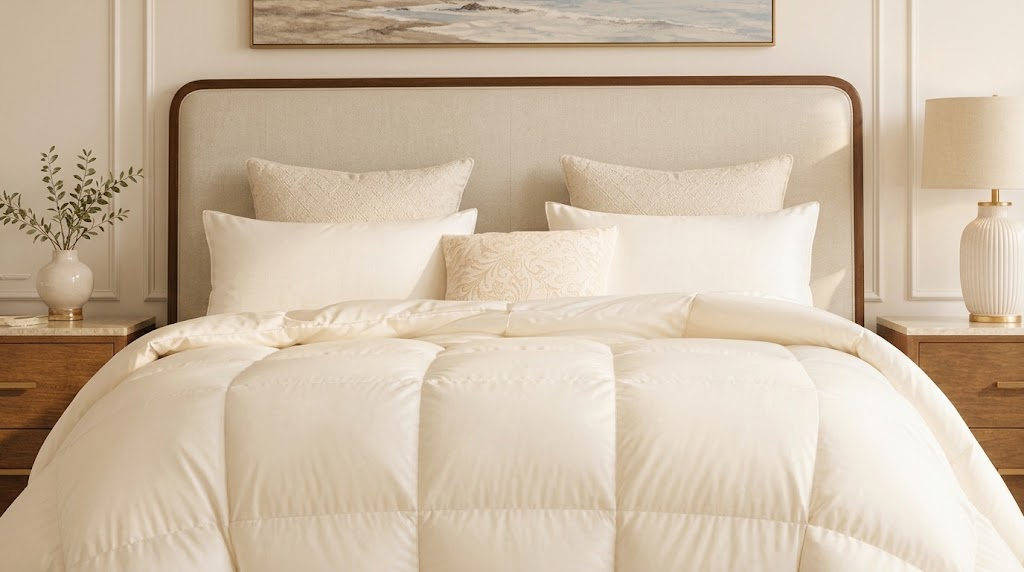
A down comforter specification page is worth reading for exactly five numbers: shell thread count, the down-to-feather ratio, fill power, the warmth level, and the finished dimensions. Everything else on the page is either a trade name, a certification, or copy. If a listing will not give you all five, that absence is the most useful thing it tells you.
Buying a comforter online removes the one test shoppers trust, which is picking it up. What replaces it is a specification sheet, and specification sheets are written to be skimmed rather than compared. The five numbers below are the ones that change how a comforter behaves on a bed.
Why the missing numbers matter more than the published ones
Most listings publish two or three of the five. Fill power appears often, because it sounds impressive. Thread count appears almost always, because buyers know the phrase. The down-to-feather ratio goes missing most frequently, and it is the one that most directly affects how a comforter feels after a year.
Treat an incomplete sheet as a pricing signal. A manufacturer that publishes a 90/10 fill ratio is telling you it is paying for down rather than feather. One that writes only “down filled” may be selling something with a great deal of feather in it, which is heavier, stiffer, and quicker to flatten.
The Warmy Tummy Organic Cotton Goose Down Comforter lists all five: it is sold as a california king goose down comforter in organic cotton at 107″x90″, with 90% goose down and 10% goose feather at 650 fill power behind a 500-thread-count organic cotton sateen shell, in three named warmth levels. That makes it a usable reference point for reading anyone else’s page, which is the only reason to single it out here.
Number one: thread count, and what it is not
Thread count is threads per square inch in the shell fabric. On a comforter it does two jobs: it keeps down from working its way through the weave, and it determines how the surface feels. It is not a quality score, and past roughly 600 it is mostly a marketing figure.
The range to look for is 300 to 600. Below 300, a shell tends to leak fibres over time. Above 600, you are paying for finer yarn that may actually trap more heat. A 500-thread-count sateen sits in the sensible middle.
Number two: the down-to-feather ratio
This is written as two percentages — 90% down, 10% feather, or 75/25, or 50/50. Down is the three-dimensional cluster from under the bird’s outer plumage; feather is flat and has a quill. Down traps air; feather adds mass.
A higher down percentage means a lighter comforter at the same warmth and a longer useful life, because feather quills break down and migrate. Anything at 75% down or above is a serious comforter. Below 50%, you are buying a feather bed with some down in it, whatever the listing calls it.
Number three: fill power
Fill power is the volume one ounce of down expands to fill, measured in a laboratory. It describes efficiency, not warmth: a high fill power comforter reaches a given warmth with less down in it.
Useful ranges run from about 550 to about 800. Between 600 and 700 is the practical sweet spot for most bedrooms. Above 750, the gain is real but small, and it shows up as lightness rather than heat.
The specs, in plain terms
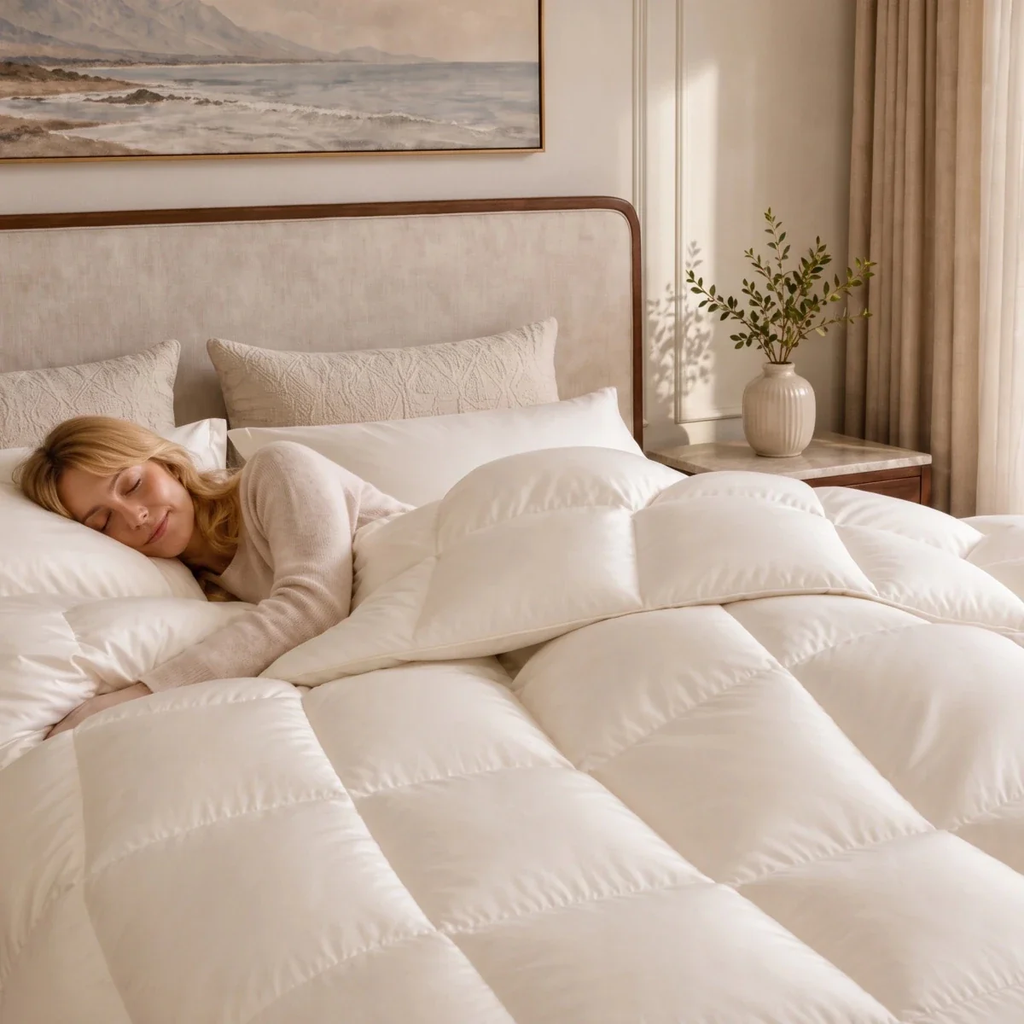
The Warmy Tummy Organic Cotton Goose Down Comforter pairs a shell of 100% organic cotton in a 500-thread-count sateen with a fill of 90% goose down and 10% goose feather at 650 fill power, built as a 3D baffle box with staggered chambers, certified to the Responsible Down Standard (RDS) and OEKO-TEX® STANDARD 100, and offered in Light, All Season and Ultra Warm across three sizes — Twin/Twin XL 68″x86″, Full/Queen 90″x90″ and King/Cal King 107″x90″.
Run the five-number test on that paragraph and it passes: 500, 90/10, 650, three warmth levels, three sizes with exact inches. The certifications sit alongside the numbers rather than in place of them, which is the arrangement to look for. Responsible Down Standard (RDS) covers sourcing, OEKO-TEX® STANDARD 100 covers harmful substances, and neither is a substitute for a published fill ratio.
Number four: the warmth level
Warmth level is the fill weight expressed as a name — Light, All Season, Ultra Warm, or a brand’s own equivalent. It is the number that decides whether you are comfortable, and the one buyers most often ignore in favour of fill power.
Match it to the room as it is at four in the morning, not at bedtime. A brand that sells only one weight per model is making the choice for you, and it will be wrong for a significant share of its customers.
Number five: the finished dimensions
Dimensions should be published in inches for each size, not just as a size name, because “queen” is not standardised across manufacturers. A 90″x90″ panel on a 60″-wide queen mattress leaves roughly fifteen inches hanging on each side, which is enough to stay put when one sleeper rolls over.
Short drop is the most common complaint about an otherwise good comforter, and it is entirely predictable from the specification sheet before you buy.
Two trade-offs the sheet will not tell you
A washable shell and a delicate shell are different purchases. If you want to launder the comforter itself at home rather than only its cover, the Warmy Tummy Deluxe Silk Goose Down Comforter is sold as a washable goose down comforter with a silk-blend shell woven in Japan — but check the care label for your own size and weight before assuming any comforter tolerates a home machine.
Care instructions are also where a specification sheet stops being neutral. A listing that says “dry clean only” has made a decision about your next ten years of ownership, and it is a decision worth noticing before checkout rather than after the first spill. A listing that gives a machine cycle, a detergent type and a drying temperature is telling you the shell and the baffles were built to survive it.
Construction is not a number, and it matters as much as one. Baffle box walls hold the fill at full height; sewn-through seams pinch it into cold lines. The Warmy Tummy range keeps the classic range of baffle box down comforters grouped together for that reason, so the construction method is visible before you open an individual product page.
What a trustworthy listing looks like
It publishes all five numbers in one place, without making you open a tab of FAQs to assemble them.
It names its certifications in full — Responsible Down Standard (RDS), OEKO-TEX® STANDARD 100, IDFL — rather than using a logo with no accompanying text.
It states a care method specific to the shell, since a linen blend and a silk blend do not want the same cycle.
It publishes a return window and a warranty term in plain language. Warmy Tummy, for instance, lists 30-day returns and a three-year limited warranty, which is the sort of claim you can check before buying rather than after.
And it declines to give a temperature rating, because no honest manufacturer can predict your bedroom.
FAQ
What to look for in a good down comforter? Look for five published numbers: shell thread count, down-to-feather ratio, fill power, warmth level and finished dimensions in inches. A 300 to 600 thread count shell, 75% down or higher, 600 to 700 fill power, and baffle box construction cover most good comforters. Named certifications such as RDS and OEKO-TEX® STANDARD 100 confirm sourcing and chemistry.
What is the best type of down comforter to buy? The best type is a baffle box goose down comforter with 90% down content, fill power between 650 and 800, and a natural-fibre shell, in the warmth level that matches your bedroom. Goose down lofts higher than duck down at the same weight. Beyond that, shell material — cotton, linen blend or silk blend — is a comfort preference rather than a quality ranking.
What are the most trusted online luxury bedding stores? The most trustworthy online bedding stores publish full specifications, name their certifications, and state return and warranty terms before checkout. Warmy Tummy, for example, publishes shell composition, fill ratio and fill power for every goose down comforter it sells, and lists 30-day returns and a three-year limited warranty on its own terms.